

Skip to content
Systems

Electrodeionization (EDI) Systems

Combining resin and selective membranes with an electric field for continuous high-purity water without chemical regeneration.

  • OperationContinuousno regeneration shutdown
  • ChemicalsNot requiredno acid or caustic used
  • PrerequisiteRO permeatefeedwater quality is critical
  • DeliverySingle sourcemanufacturing, piping, commissioning

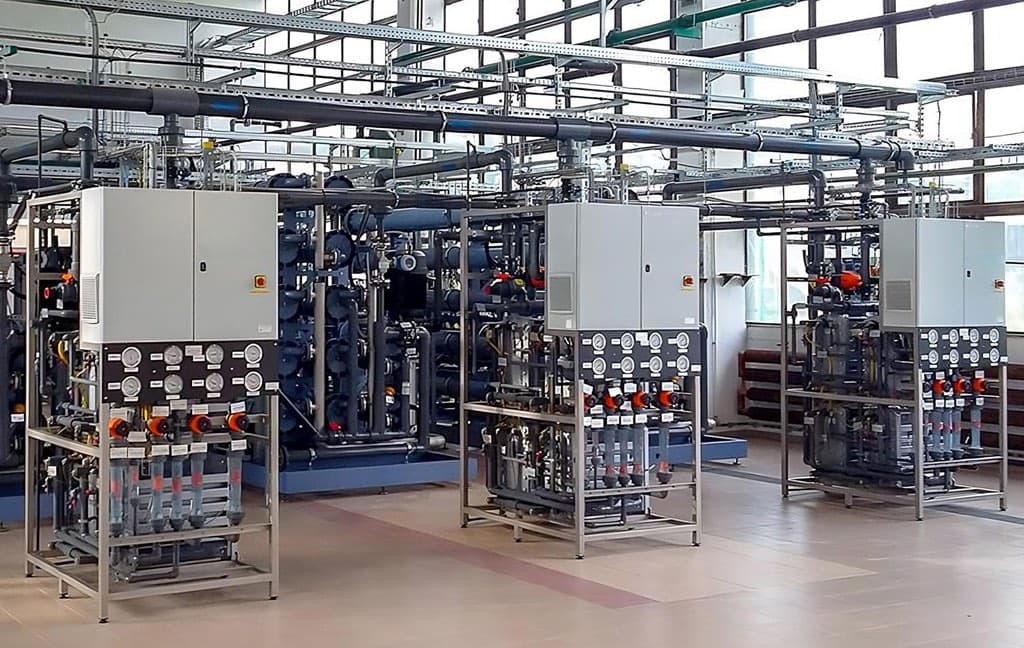
EDI uses ion exchange resins together with selectively permeable membranes under an electric field. As water passes through resin-filled compartments, cations move towards the cathode and anions towards the anode; the membranes admit only certain ions and collect them in a separate reject stream.

Its most decisive characteristic is continuity: because the resin is continuously regenerated by the electric current, there is no need for the acid–caustic regeneration of conventional demineralization, nor for the shutdown that regeneration brings.

Electrodeionization (EDI) Systems
How it works

Stages

  1. 01

    RO as first stage

    EDI is fed with water from a reverse osmosis outlet; it does not work without that stage.

  2. 02

    Module inlet

    Water passes through resin-filled compartments separated by membranes.

  3. 03

    Electric field

    Ions are carried towards the electrodes; the resin stays continuously regenerated.

  4. 04

    Permeate

    High-purity water goes to the process, the concentrate to the reject line.

Where it is used

Typical applications

  • High-pressure boilers

    Feedwater that must stay at low conductivity continuously.

  • Sensitive production

    Process lines that need uninterrupted high purity.

  • In place of a mixed bed

    Avoiding chemical storage and regeneration waste.

  • Polishing after RO

    Bringing the reverse osmosis outlet to its final quality.

EDI’s requirement: clean feedwater

An EDI module is not a treatment system in itself; it is designed to be fed with water from a reverse osmosis outlet. If the feedwater carries hardness, chlorine or a high organic load, the module loses performance quickly.

That is why we always engineer EDI as a whole together with the RO ahead of it and the pretreatment ahead of that. A decision made by looking at a single stage puts the next stage at a loss.

Frequently asked questions

Can EDI replace a mixed bed?

With suitable feedwater, yes — and it requires no chemical regeneration. If the feed quality does not hold, a mixed bed may be the safer choice.

What does it cost to run?

The main item is electricity; the cost of acid, caustic and regeneration waste disappears. We make that comparison in our efficiency calculations.

Can it be added to our existing RO line?

If the outlet quality and flow rate of the existing RO are suitable, it can; we carry out a system analysis first.

Send us your raw water analysis and the flow rate you need

Let us size the system together; we will survey the site in person if needed.